

Thank you for Subscribing to Media Entertainment Business Review Weekly Brief
Media Entertainment Business Review: Specials Magazine
With 10+ years in progressive HR across media, education, non-profit, and construction manufacturing, Shynelle now serves as Director of IDEA at OMG Canada. She leads a multi-year strategy focused on People, Clients, and Community, aiming to create lasting change within the organization and beyond, with an emphasis on empowering equity-deserving groups and driving scalable impact. 1. Could you briefly overview your professional background and current role and responsibilities at Omnicom Media Group? With 10+ years of experience in progressive HR, Shynelle’s industry experience spans media, education, non-profit, and construction manufacturing. Since joining OMG as the Director of IDEA, Shynelle has led a comprehensive, multiyear strategy centered on three core pillars — People, Clients, and Community. This roadmap is designed to create lasting change both within the organization and beyond, with a focus on empowering equity-deserving groups and driving scalable impact. 2. Fr

Streaming Media Company Of The Year 2025
The global streaming industry is on a rapid growth trajectory, driven by shifting consumer habits and increasing demand for digital entertainment. In the U.S., subscription-based streaming continues to expand as younger audiences move away from traditional pay TV, seeking platforms that better fit their digital-first lifestyles. Despite obvious opportunities, the streaming industry has seen little movement in the launch of new tier-one platforms over the past five years. Enter MolQ Entertainment, a company set on enhancing the streaming experience with the launch of two global platforms, mQ TV and mQ Films. mQ TV is a virtual cable operator or vMVPD, designed to deliver a broad selection of TV networks across the U.S., Canada, the Caribbean and the UK. Meanwhile, mQ Films is a dedicated global streaming service poised to compete directly with industry giants like Netflix, Amazon Prime and Disney+. While most platforms house all their content under a single interface, MolQ walks a different path and separates TV and film content into distinct apps. Both services will have a Q3 2025 launch, with expansion plans extending through 2027. “Both our platforms will operate under advertising supported video on demand (AVOD) and subscription video on demand (SVOD) models to help provide users with flexible pricing options,” says EJ Klein, founder and CEO. As leading streaming services continue to raise their subscription fees, MolQ’s model makes it an affordable alternative. At launch, MQ Films will contain 1,500 hours of content per territory, featuring independent films, documentaries, series and original productions curated from global film festivals. mQ TV, on the other hand, will provide access to over 50 linear TV networks. The company is also enroute to launch MQ Sports, a dedicated sports network for women’s sports, international leagues and collegiate athletics and a 24/7 global news network that targets millennials and Gen Z with comprehensive and unbiased news coverage. These offerings set MolQ apart from competitors, who usually don’t include standalone sports and news networks within their streaming ecosystems..

Sports Management Software

The youth sports landscape is characterized by varying levels of accessibility, efficiency, and cost, which presents the need for a solution that enables talented athletes to shine. Enter PANDA Stronger, a specialized platform crafted to address these issues, especially at the youth level. An acronym for performance, analytics, and data, PANDA Stronger is a game-changing solution that bridges the divide between coaches, athletes, parents, and colleges. By focusing on unity, efficiency, and affordability, it redefines how the entire athletic ecosystem interacts and grows. “PANDA Stronger is like an amalgamation of LinkedIn, Instagram, WhatsApp, and Moneyball with youth sports, or simply—data analytics meets social networking," says D. Glen Parillo, founder, chairman, CEO, and CFO of PANDA Stronger. This allows the platform to solve existing inefficiencies by integrating team management, individual profile management, college recruiting, social networking, and social media into one ecosystem. But PANDA Stronger isn't just a management tool; it's a platform for self-improvement and growth. With a proprietary algorithm capable of calculating a person's athleticism, athletes can now quantify and compare their performance against their peers. Drawing analytical comparisons akin to fantasy sports, the platform uses data from over 340 customizable workouts. From tracking daily workouts to analyzing strengths and weaknesses, this robust system helps athletes understand where to improve.
Cinematic and Entertaining Fiction Publisher
Over one-third of the movies made in Hollywood in the last 60 years have been based on books, and many of them have gone on to become blockbusters. While some of these books are renowned franchises, others are lesser-known literary works chosen from the four million books published annually. Until now, investors in the entertainment industry have spent extensive resources trying to find novels that check all the boxes for a successful adaptation. Level 4 Press has introduced a better alternative to connect distinctive literary works with film and television buyers looking for their next blockbuster. The robust book-to-screen pipeline designed by Level 4 Press reverse-engineers the process of adapting books to the silver screen. Rather than trying to find a suitable novel from the hundreds of thousands of published works, Level 4 Press employs skilled writers to develop original ideas. It identifies a suitable idea for a film or television series, then assigns an author to flesh it out and expand it into a novel. The authored novel is published and then turned into a film or brought to film and television buyers as original intellectual property. “Our distinctive business model differentiates us from other companies that approach IP creation, acquisition and exploitation in a less holistic way,” says William Roetzheim, CEO of Level 4 Press. This is especially useful in an industry where the path for turning an idea into a film is extremely difficult, inefficient and uncertain. In contrast, Level 4’s book-to-screen model is highly efficient, as it allows the firm to maintain a steady IP stream, with all rights owned and controlled by Level 4, which makes the rights acquisition and contracting uniform, streamlined, and sustainable. And by cutting out various “middlemen” along the way, Level 4 can focus on quality, while capturing value as the IP moves along the pipeline.

CXO INSIGHTS

Embracing Innovations And Overcoming Challenges
Ann McGlinchey, Vice President, CXM, CMI Media Group

Creating Captivating Sounds with AI-Powered Tools
Patrick Magee, Director, Audio Post-Production/Scripps Networks, The E.W. Scripps Company [NASDAQ: SSP]

The Cinematic Power of Great Digital Transformations
Jeff Rosenfeld, SVP Digital and Customer Experience, Cinemark Theaters

The Glue, The Shield, The Fun Police: What Makes a Good Producer?
Allan de Leon, Production Manager, Activision Blizzard

Navigating the AI Frontier
Cleber Redondo, 3D Director, NBCUniversal


IN FOCUS
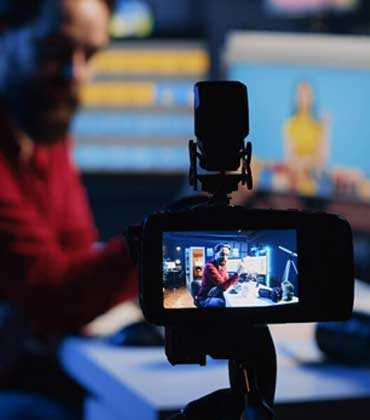
The Digital Revolution: Streaming Media's Impact on Accessibility and User Experience
Advancements in streaming media enhance user accessibility, drive interactivity, and inspire content innovation, transforming the way people connect with digital entertainment worldwide.

Transforming Entertainment: The Journey of Streaming Media and Innovation
Streaming media grows through device ubiquity, improved networks, and cloud-native delivery; innovation centers on low-latency, personalization, and sustainable monetization across diverse use cases.
EDITORIAL
Navigating the Next Wave of Media Production
The media and entertainment industry is undergoing a rapid reinvention. As audiences shift across platforms and consumption patterns become more fragmented, content creators and distributors face a dual mandate. They must deliver more immersive, high-quality content faster and at scale, all while adapting to new technologies and evolving business models.
This is particularly evident in streaming media, where the demand for cinematic storytelling is pushing creators to produce high-value content across multiple formats. At the same time, cinematic fiction publishers are increasingly tapping into serialized formats to engage global audiences, blending compelling narratives with state-of-the-art production tools. In parallel, industries like sports are leveraging sports management software to enhance real-time fan engagement and optimize content delivery, reshaping how live events are experienced.
This transformation brings both opportunity and complexity. From cloud-based editing suites and AI-driven scripting to virtual production and real-time rendering, workflows are evolving. Yet, at its core, success remains rooted in compelling storytelling, tight collaboration and operational precision—whether creating a gripping drama or a dynamic sports broadcast.
One of the biggest challenges is meeting the growing demand for content. Productions must move faster with hybrid, often global teams, requiring seamless coordination across creative and technical departments. The tools are evolving, but strategic implementation is the key to delivering real value.
Leaders are investing in future-ready infrastructure and talent. Cloud-native pipelines, virtual collaboration platforms, and advanced tech are becoming standard. There's also a renewed focus on up-skilling to unlock productivity at every stage of production.
In this edition, we explore how forward-looking studios and service providers are aligning creativity with technology to meet rising expectations. From post-production to final delivery, we spotlight the companies setting new standards for agility, quality, and scalability.
We also feature insights from industry leaders such as Allan de Leon, Production Manager at Activision Blizzard, and Patrick Magee, Director, Audio Post-Production/Scripps Networks at The E.W. Scripps, who share their views on the current production landscape, the evolving role of tech, and what it takes to thrive in a high-velocity content economy.
